In the Press...
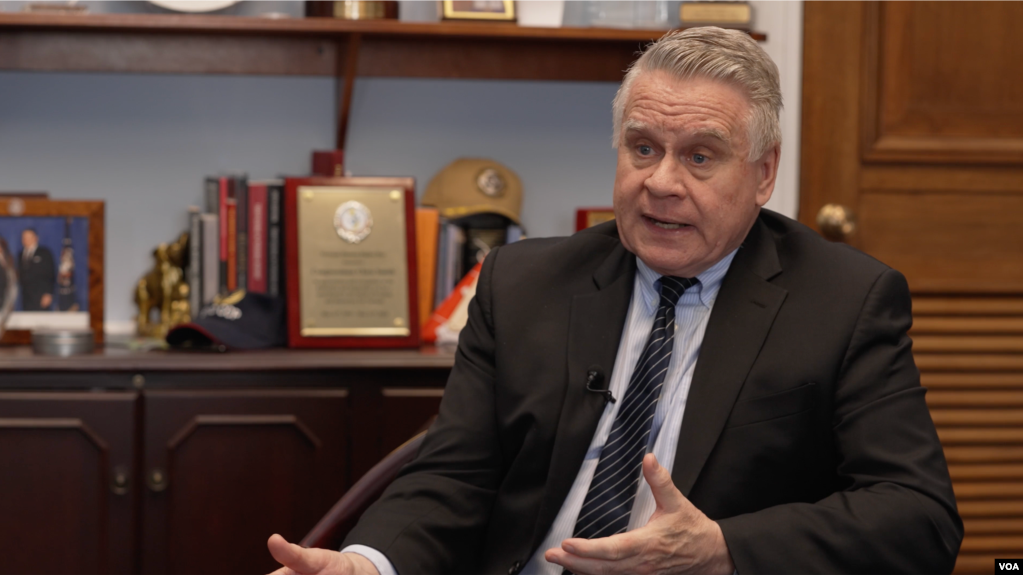
Exclusive VOA interview with Rep. Smith'"Let him go": Congressman Chris Smith gave an exclusive interview to VOA, hoping that President Trump would ask Xi Jinping to release Jimmy Lai in person'By Yihua Lee Capitol Hill — As the leaders of the United States and China are expected to meet in mid-May, a Republican congressman in the U.S. Congress who has long been concerned about human rights issues said that U.S.-China relations should be based on truth and the defense of human rights. The veteran Republican also called on President Donald Trump to mention the case of Hong Kong's pro-democracy media tycoon Jimmy Lai during the talks and asked for Jimmy Lai's medical parole. Republican U.S. Rep. Chris Smith from New Jersey recently said in an exclusive interview with VOA on Capitol Hill that he hopes human rights issues will become one of the core agendas of the U.S.-China summit. He revealed that he had communicated "extensively" with the executive branch about the importance of Jimmy Lai's case, hoping to ensure that Jimmy Lai's release was a top issue.
"We sincerely hope that during the face-to-face meeting, the president will look Xi Jinping in the eye and say, 'Let this man go,'" Rep. Smith, who co-chairs the China Committee on Congress and Executive Authorities (CECC), told VOA on March 27. He continued: "What does it bring you to imprison such an extremely kind, compassionate, and elderly elder? Frankly, such cruelty to others will only make Xi Jinping and the Communist Party feel ashamed. Let him go. I hope you can learn from the Liu Xiaobo incident. At that time, after Liu Xiaobo won the Nobel Peace Prize, you made him torture in prison, neither allowing him to be released from prison to receive the award, nor allowing his wife to attend on his behalf; As a result, he died of illness without receiving the necessary treatment. To this day, I am still shocked by this. This reflects their humanity. Perhaps they think it doesn't matter. But frankly, since ancient times, anyone who abuses their own people has a bad historical reputation. If they really want to leave any valuable legacy, they must start showing compassion, and they can start by showing compassion for Jimmy Lai.” Smith mentioned that current Secretary of State Marco Rubio worked alongside him at the CECC when he was a senator in Congress, pushing for bills and speaking out on human rights issues in China. Smith said he believes Rubio will properly include Jimmy Lai's related issues on the agenda at the next US-China summit. "Jimmy Lai is a hero. He deserves the Nobel Peace Prize, maybe he will. He speaks the truth to those in power. He did so with compassion and without hostility, even towards those who imprisoned him," Smith told VOA. "What he (Jimmy Lai) does is good. He could have fled Hong Kong when the general trend was gone, and seeing Hong Kong unfortunately go in the wrong direction. But he chose to stay. He stayed with Apple Daily, he stayed with his reporters and, above all, with the people. Because he insisted, and I think his argument is very convincing, that everyone deserves to enjoy basic human rights, and that the Basic Law provides for the protection of basic human rights. However, this guarantee has now been torn apart by Xi Jinping. They also had the Sino-British Joint Declaration, which also guaranteed basic human rights, freedoms and democracy. Unfortunately, all of this has now been overturned by Xi Jinping. But Jimmy Lai is an amazing person. He was sentenced to 20 years in prison. He is 78 years old; If he is released in the future, he will be 98 years old, if he can live to that time. His physical condition is very bad now. Therefore, we call on Xi Jinping and the Hong Kong authorities to grant him parole based on humanitarian considerations. I mean, at the very least, the Government should at least grant the release of such a person who has not committed any crime, on the basis of his extremely critical health.” Jimmy Lai, the founder of Hong Kong's "Apple Daily", was sentenced to 20 years in prison by the High Court of the Hong Kong Special Administrative Region on February 9 on charges involving the National Security Law, including "conspiracy to collude with foreign forces". The 78-year-old pro-democracy media mogul was already serving a prison sentence in December 2020 for fraud charges alleged by authorities and has now been in custody for more than five years. U.S. Secretary of State Rubio later issued a statement saying the verdict was "unjust" and called on the authorities to give Jimmy Lai "humanitarian parole." Members of both parties in the U.S. Congress have also expressed strong concern about Jimmy Lai's sentencing. Rep. Jim McGovern, a senior member of the CECC Democratic Party, said after the 20-year prison sentence was released, "The sentence of 78-year-old Jimmy Lai to a substantial life sentence is simply ridiculous." He is a principled defender of press freedom – and the Hong Kong authorities have kept him in prison for so long. Jimmy Lai should be released on humanitarian grounds, and U.S. officials should continue to urge Hong Kong authorities to release him.” After Jimmy Lai's resentencing, White House spokeswoman Karoline Leavitt said that Jimmy Lai's case was important to President Trump. "I have heard the president publicly and privately call for this. I had the privilege of attending the meeting between President Trump and President Xi in South Korea, and the President himself mentioned it. This is important for the president," Levitt said at a press conference on February 10. In December, after Jimmy Lai's conviction, President Trump confirmed that he had urged Jimmy Lai's release during a meeting with Chinese leader Xi Jinping last October. Trump said: "He is old and not in good health. I did make a request, we'll see.” The White House said President Trump will visit China on May 14 and 15 and will meet with Chinese President Xi Jinping in Beijing. Trump's planned visit to China is the first visit by a U.S. president to China in nearly a decade. President Trump posted on social media that he was looking forward to spending time with Mr. Xi Jinping and expected it to be a "landmark" visit. The White House also said that President Trump will then receive Xi Jinping, who is "returning" to Washington, but has not disclosed details at this time. Smith hopes that the U.S.-China relationship will pay attention to human rights issues For Smith, who has been following China as a member of the House of Representatives since the 1980s, trade and human rights should never be decoupled. Smith called on the U.S. China agenda to make human rights a priority. "I hope that in bilateral relations, we will be very, very tough on human rights issues. Again, why? If you can be kind to your own people, then you will naturally respect intellectual property rights and perhaps do better than you do now. Now they just take away patents and copyrights and keep them for themselves. How many American and European companies have their valuable intellectual property stolen by the Chinese Communist Party and are now in their hands? There is no rule of law there. So I think we have to be very, very firm on human rights," Smith said. "If we can get it right, even if there is a downturn in the economy during the transition, it doesn't matter. This is what the people deserve.” Smith went on to say that China's strict censorship of information has made it impossible to build exchanges between the two countries on the truth. He has criticized big US tech giants for years for pandering to the Chinese government's censorship of speech. He said in this interview, "If you are willing to kowtow and do what Xi Jinping wants, maybe he will not trouble you; But as long as you cross the line a little, he will come to the door immediately. We can see this from the internet to see how they monitor the network. In 2005, I hosted a high-profile hearing with companies such as IBM, Cisco, Microsoft, and Yahoo. I couldn't believe that these companies were helping to review everything. If you were using Google search engine in China at the time, what results would you get? It's just a bunch of beautiful pictures of everyone smiling in Tiananmen Square. Some of the pictures are true. But the tanks are gone, there is no Tiananmen Square massacre, all of which is thoroughly censored. Once I typed a lot of content into an Internet café in Beijing, including my own name, and a lot of negative information popped up. I type 'George R. W. Bush', and also found a lot of negative information about him. Then enter 'Tiananmen Square' and there is no result. So they instill one lie after another in their own people.” He added to VOA: "As we said many years ago, the 'bamboo curtain' is not soundproof. In the past, it was often said that Europe had an 'iron curtain' and parts of Asia had a 'bamboo curtain'. You pierce it with the truth.” Congressman Smith continued: "You need to know that I have received students and university students from China here. They sat down and talked to me for 45 minutes to 1 hour or more. Once, I asked one of my students to go to my constituency to talk to high school students, and they all said that the Tiananmen Square massacre never happened. Their attitude is very resolute. It could even be said that they even looked angry because I mentioned that it was true, because I asked them, 'What have you been taught? They replied, 'Mr. Parliamentarian, what are you talking about?' That didn't happen at all! These lies must be completely exposed. The relationship between the two countries must be based on truth and on basic human rights. Again, they do not respect any of these principles.” The issue of forced organ harvesting in China has attracted the attention of lawmakers from both parties In a politically polarized political climate in Washington, lawmakers from both parties have unanimously expressed concern about human rights issues in China and the current state of Hong Kong's autonomy. In the interview, Smith criticized the Chinese government's long-enforced one-child policy and the increasingly important issue of forced organ harvesting. Rep. Smith emphasized that these human rights are not rights of the United States, but are universally recognized human rights ratified by the United Nations. "The same is true for the widespread torture and the forced abortion policy that has destroyed countless families in China," Smith said. I mean the missing girls – the consequences of the 'one child per couple' policy will be irreversible for generations. They are gone forever. Two generations of women ceased to exist, and they were killed simply because they happened to be girls when they were still in their mother's womb. I remember one of the hearings I presided over – I had presided over many hearings on the 'one child per couple' policy – and one witness said: 'You know what? If you add up all the women and girls living in the United States and look at the two countries of China and India separately - unfortunately, there is also gender genocide, gender selection and abortion in India - you will find that in terms of numbers, the two are equal. In other words, every woman you see in the United States, or hear about every woman who lives here, has a total of the same number of lives that have been ruthlessly wiped out by China's forced abortion policy. Today, China is reaping the bitter fruits it has planted. Men can't find wives. First, the women who were supposed to be alive disappeared - they had the right to live in this world. Second, as men cannot find a spouse, the family structure also collapses. This situation is completely predictable. I had predicted this at the hearing; I have predicted this in the legislation I pushed for the House of Representatives. I have pointed out that forced abortion was characterized as a 'crime against humanity' in the Nuremberg war crimes trials – and in China, it has been rampant for 40 years and has not completely disappeared.” "They also engage in forced organ harvesting, which is forced. If I, you, or one of us dies or has an accident and voluntarily donates a cornea or other body organ to a recipient in need, that's fine. That is voluntary. But in China, this is completely involuntary. As part of the genocide against Uyghurs, Falun Gong practitioners, and Tibetan Buddhists, they targeted these people. The number of Uyghur victims now exceeds even more than any other group. They traffic these organs, forcibly harvesting two to six organs from each victim, and victimize tens of thousands of people each year. It's simply unbelievable," Smith said excitedly in the interview, "just imagine that each victim was forcibly harvested two to six organs, half male and half male, and the average age was 28 years old. They pick the healthiest people and sell them or, like selling livers, give them to donors from the CCP's elite. If Xi Jinping needs a liver transplant tomorrow, his so-called 'doctors' will find a young victim and forcibly remove his organs and transplant them into his body.” Rep. Smith and Democratic U.S. Rep. William Keating co-sponsored the Stop Forced Organ Harvesting Act in February last year. The bill was passed by the House of Representatives in May last year and sent to the Senate for consideration. The bill would impose sanctions on anyone involved in organ transplants, including visa revocation, and loss of immigration benefits, while also facing criminal penalties of up to $10,000 and 20 years in prison. In addition, senators have introduced similar bills on forced organ harvesting in China. Republican Senator Ted Cruz and Democratic Senator Jeff Merkley of the Senate Foreign Relations Committee jointly introduced the Falun Gong and Victims of Forced Organ Harvesting Protection Act on March 11. It aims to sanction those responsible for the forced harvesting of human organs in China. The bill not only requires the president to submit a list of relevant personnel to Congress, but also requires the secretary of state to submit a report to Congress on organ transplant policy and practice in China. The bipartisan bill requires the President of the United States to submit a list to the relevant congressional committees of persons determined by the President to have intentionally and directly engaged in or facilitated forced organ harvesting in the People's Republic of China. All property of these individuals is prohibited from trading in the United States or with American personnel, and the United States will refuse to issue them entry visas, and existing visas can be revoked. Smith: What drove me to pay attention to human rights in China came from my religious beliefs Rep. Smith from New Jersey has been a strong critic of China's human rights situation for decades since entering Congress in 1981. Whether U.S.-China relations are tense or de-escalated, he has never stopped condemning the Chinese authorities' oppression of religious freedom and forced abortion, and has continued to introduce or co-sponsor related bills in the House of Representatives. In the mouth of Chinese state media, he is an "anti-China veteran" and has been sanctioned by Beijing more than once. Rep. Smith is still on China's sanctions list and is barred from entering China. At a time when both parties in Congress see Beijing as Washington's biggest rival, Smith remains one of the most active lawmakers on human rights issues in China. He said that his religious beliefs have driven him to continue to pay attention to human rights issues for many years and speak out for human rights in China. "For me, it's my faith. I am Catholic. I firmly believe that we must treat everyone with respect," Smith said. "This faith has always been the driving force for my actions, and so has my wife. We are committed to addressing many issues, such as the right to life of unborn children, as well as various other human rights issues, not only in China but around the world. I first focused on China because of forced abortion, and then focused on religious freedom, or the lack thereof. We have spoken out for decades, both in Hong Kong and in Chinese mainland, where church members have been subjected to extremely brutal persecution.” He also mentioned a meeting with Su Zhimin, the leader of the Chinese underground Catholic Church. "In 1994, I met with a Catholic bishop, Bishop Su of the Diocese of Baoding," he said. He was truly a saintly benevolent man. He spent more than 30 years in a labor camp, where he was held in extremely small cells, abused, deprived of food, and beaten. But he prayed for those who tormented him. In the Christian Bible, we are taught to love those who hate you, to be kind to those who persecute you, and to pray for them. Bishop Sue went through that ordeal, and about two years after I left, he returned to that ordeal, and he was arrested again and imprisoned. But he still stuck to his beliefs, and I wasn't sure if I could do that, I don't think I could do it.” "If Xi Jinping is smart enough - he is indeed a smart man, but he is not a wise man, this is the difference. If he is truly wise, he will accept the Chinese faith community. These are very law-abiding people who care deeply about their families, their country, and their neighbors. They are the most important asset you can have. Why do this? Is it just because he can't fully control them? You know, faith is a beautiful gift in itself, and he is suppressing it," Smith told VOA at the end of the interview. |